
Welcome to the Flowbat Project!
Affordable power, stronger WA.
Our vision is to drive Western Australia’s energy transition forward and unlock Australia’s true potential; affordable energy, to facilitating a new era of re-industrialisation and economic diversity, right here in WA!
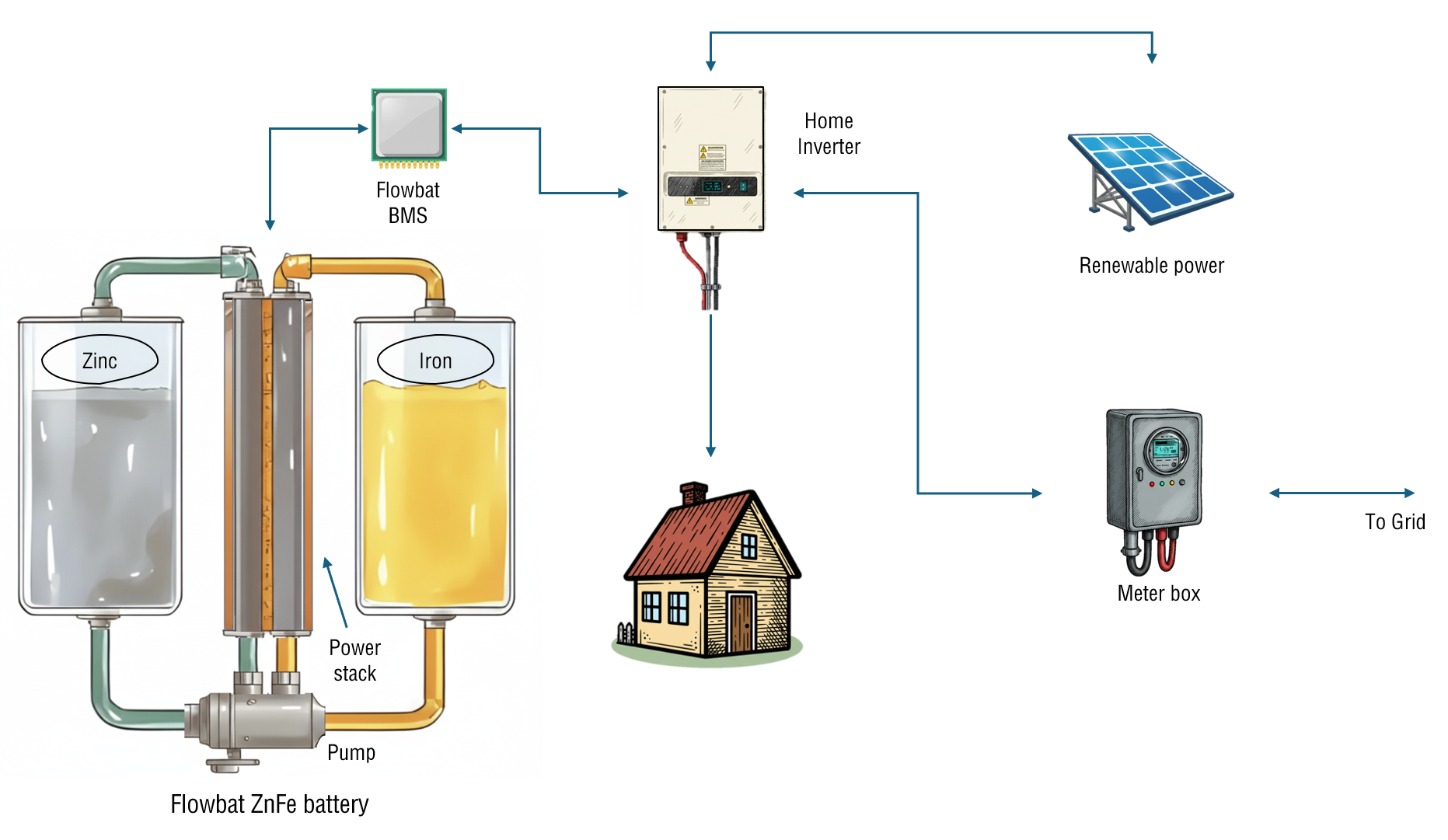
Zinc-Iron has the potential to end the endless debate of flow battery chemistries
Low-cost, and safe electrolytes
ZnFe flow batteries only use zinc oxide, sodium hydroxide and potassium ferrocyanide as electrolytes, which are cheap, have a robust supply chain, and are non-toxic.
Versatility in deployment with zero thermal run-aways
The electrolyte in ZnFe flow batteries are strictly non-combustible, and there is no risk of thermal runaway. This means flexible deployment and no additional costs incurred by managing fire risks.
Complete decoupling of power and energy
If more power is desired, scale up reaction stacks, if more energy is desired, acquire bigger tanks. This means much greater scalability, modularity, and cost effectiveness within a wide range of energy storage scenarios.
Robust performance
We are pushing the Flowbat ZnFe cell beyond the current state-of-the-art with a combination of a unique battery management system built on top of high-performance control algorithms, and cutting-edge flow-field shape optimisation.
Designed for maintainability and ease of ownership
A drawback of flow batteries is that the conventional stack design leads to electrolyte leakage. We are designing a leak-proof bottled-stack, to fully actualise the potential of flow batteries.
Simple manufacturing
Our approach is a quasi pre-fabricated mini-stack allows simple and scalable stack assembly, even for bespoke system designs. Combined with low-cost raw materials, this allows us to be price-competitive even with existing lithium ion manufacturers.
The challenges ahead
ZnFe chemistry has the makings of a flow battery king—but a handful of hidden traps have kept it from claiming the throne.
A zinc battery is always one dendrite away from a blackout
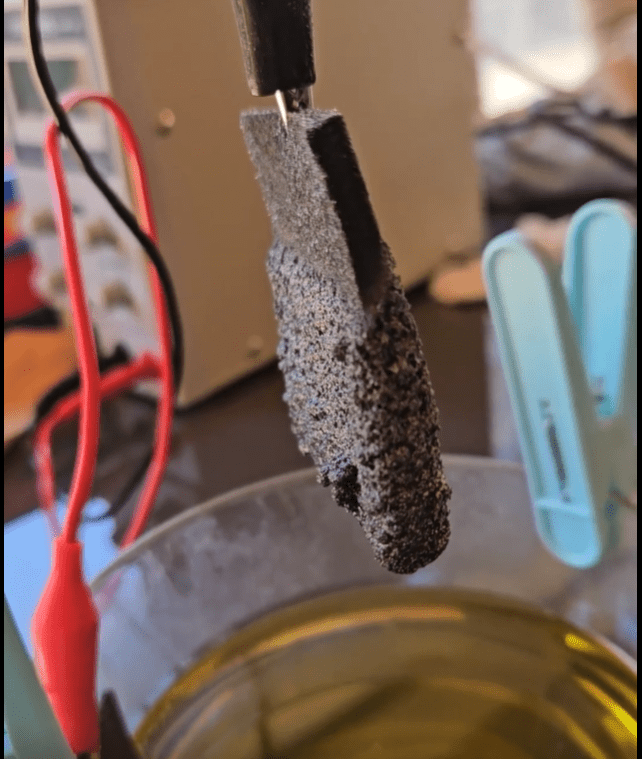
The ZnFe flow battery relies on the plating of zinc metal on the electrode to store electricity. Under standard operating conditions and cell design, the zinc does not plate evenly, and can eventually result in long ‘tendrils’ of deposited zinc metal, resulting in battery failure caused by piercing of the separator membrane. Flowbat has conducted experiments to visualise the occurrence of this phenomenon, by plating zinc from zincate solution onto a carbon felt electrode – see right figure.
Hydrogen formation – a problem for energy storage?
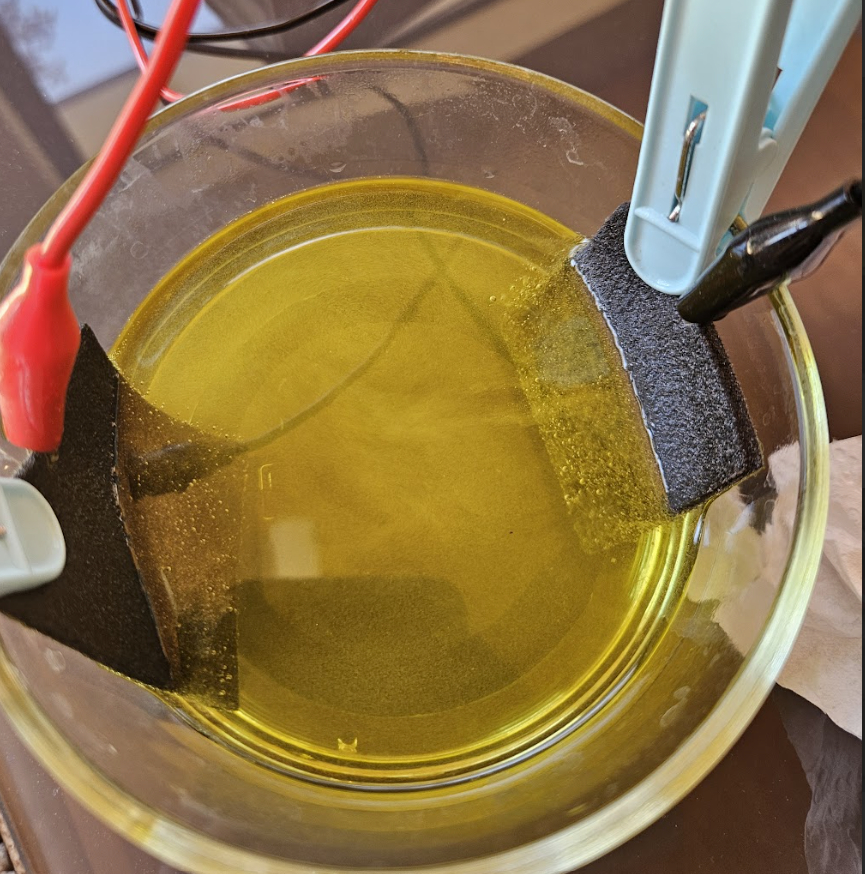
When charging batteries, energy is lost when unwanted chemical reactions compete with the desired redox reaction. During charging of the ZnFe flow battery, zinc ions plate onto the electrode as zinc metal, which depletes its concentration around the electrode. This phenomenon facilitates the competing reaction of water electrolysis, forming hydrogen and oxygen gas, which bubbles out. The energy used to drive this competing reaction is energy that the battery cannot store – see left image (right electrode is hydrogen, left electrode is oxygen). So, the higher the rate of these reactions, the lower the charging efficiency, or the amount of energy lost between charging and discharging.”
If there’s a space, liquid will find it’s way through
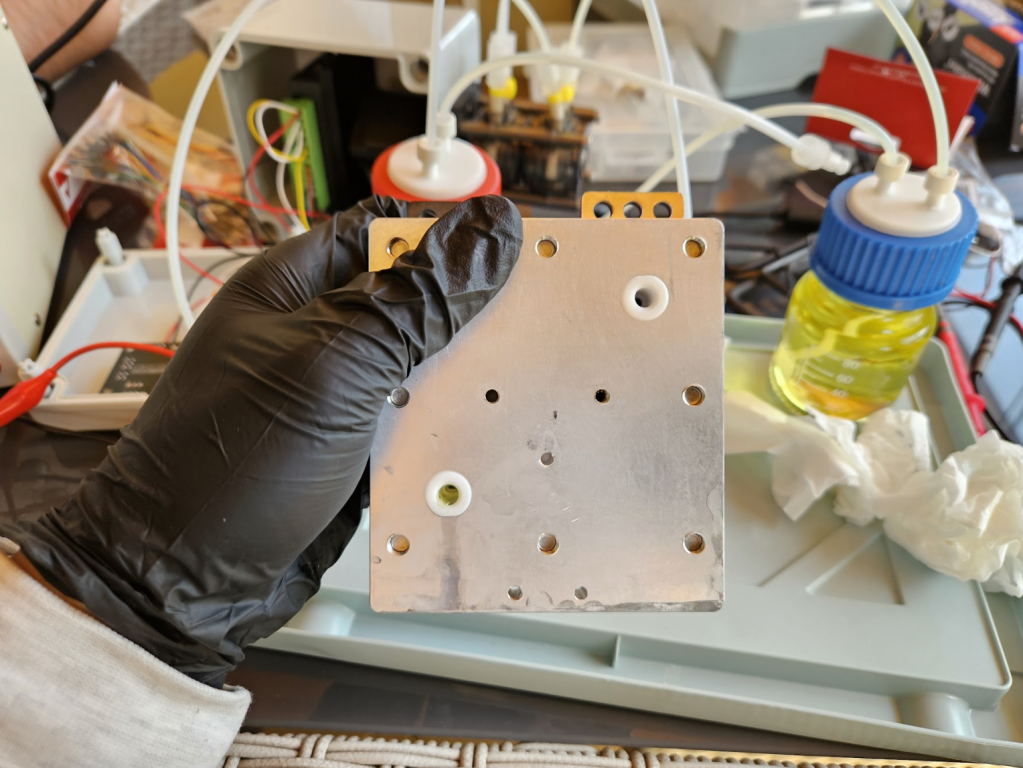
Those with a plumbing or mechanical engineering background will be familiar with the saying that “if there’s a gap, water will get through”. The conventional flow battery design involves sandwiching the stack components between bulky steel plates, secured by heavy duty bolts and sealed with rubber seals, and chamfers on membrane compartments. For the purposes of small-scale R&D, this design is sufficient. However, having experienced it personally, this “sandwich” design is very cumbersome to work with and can have severe leakage issues – see right image (zinc has plated on the outside of the battery stack).
What does it all mean for the ZnFe battery?
The three points discussed above are the Achille’s Heel of ZnFe flow batteries. If not addressed, they will both reduce the charging efficiency of the battery and shorten its lifespan significantly. Every time the battery is charged, the operator must hope that the membranes in the ZnFe cell will not be pierced. Even if that did not happen, hydrogen gas will be seen bubbling out of the stack, upsetting the pressure balances and forcing the electrolytes out of any sliver of space.
In short, the ZnFe battery, designed in the standard way, would not last very long at all, and so has remained in R&D limbo for many years, despite possessing so much potential.
Is it doomed for the technology? Will there be a comeback story?
The answer is – surprisingly – a no, followed by a YES! Flow battery technology faces many challenges, but there’s also real hope. That classic “sandwich” stack design? It’s not the only way. The flow channels? They don’t have to remain the same. Even the charging method doesn’t need to be just like lithium-ion batteries.
We can rethink the stack entirely; no more relying on hopes and dreams for perfect seals! But, it takes deep design expertise. The current layout exists simply because it’s straightforward and efficient for small-scale R&D, good enough to pump out some academic publications, not because it’s the only way of designing flow batteries. The design of truly usable flow battery stacks requires a multidisciplinary approach, relying on insights from fluid dynamics, materials science, electrochemistry, and even computational chemistry. And charging them? That in itself is a control engineering and power electronics challenge.
At Flowbat, we believe the path forward lies in bold redesigns. With the right team, there’s massive room for improvement, and we’re ready to reshape how the world sees flow batteries once and for all.
The Flowbat way
High performance battery management system (BMS)
The BMS for a flow battery should be tailored to its internal mechanics and the nature of the chemical reactions occurring within it, instead of being the exact same as other BMS’. A specialised high-speed charging algorithm will be developed to significantly reduce parasitic reactions.
Radical stack design
A stack is not very useful if it leaks. We will introduce a HDPE bottled design to reduce stack weight and eliminate electrolyte leakage. This will incur an efficiency penalty, which will be alleviated through Computational Fluid Dynamics (CFD) simulation with shape optimisation.
Flow channel optimisation
Shape optimisation with computational fluid dynamics isn’t common in flow battery design, and using multi-scale simulations to guide it is even rarer. But these tools let us rethink the entire flow field, designing it to control zinc metal plating and fine-tune reaction speeds. It’s a game-changer – like what dimples did for golf balls, we’re doing for flow batteries!
-
Follow us on our developmental journey!
 Flowbat